
In order to improve our services and the browsing experience, we inform you that we use cookies.
Accept
Refuse
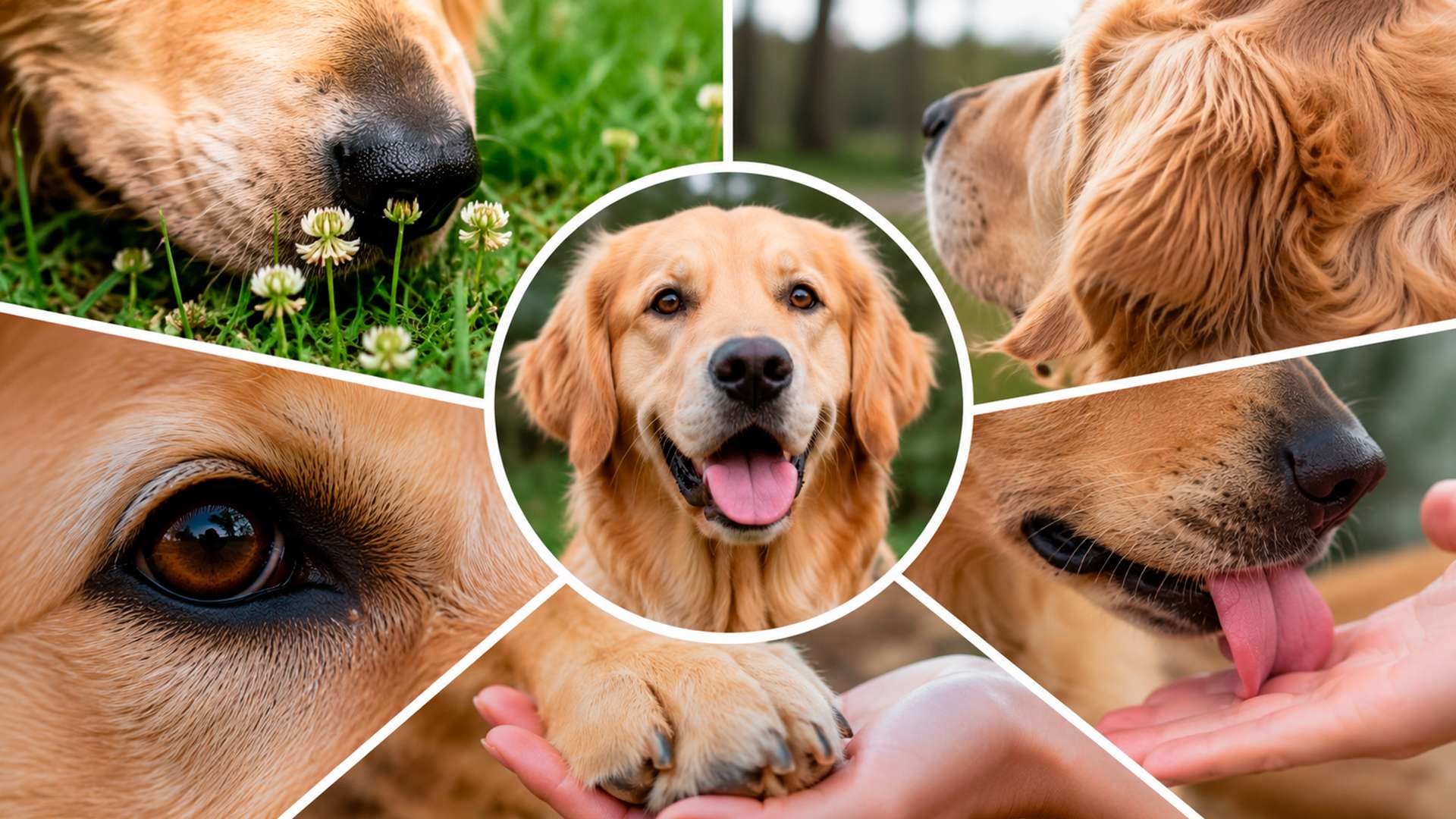
Smell, hearing, sight, taste and touch: discover how these senses differ from humans and how they shape your dog's behaviour
Dogs have lived alongside humans for thousands of years, but they still experience the world in their own unique way. The way they hear, smell, see, feel and taste is very different from ours—and that explains many behaviours that may seem "strange" to us. Understanding a dog's five senses helps improve communication, better interpret certain behaviours, and even choose more suitable toys, routines and forms of enrichment.
1) Hearing: They Hear Much More Than You Think
Hearing is one of the most highly developed senses in dogs. They can detect sounds at much higher frequencies than humans. In other words, what seems like silence to us may be perfectly audible to them.
This helps explain why dogs react to sounds we cannot hear, become anxious during fireworks or thunderstorms, and notice footsteps or distant noises before we do.
In addition, many breeds can move their ears independently in different directions, allowing them to pinpoint the exact source of a sound.
2) Sight: They Don't See in Black and White (But They Do See Differently)
One of the most common myths is that dogs only see in black and white. In reality, they can distinguish colours, although their colour perception is more limited than ours.
Simply put, they see blues and yellows more clearly, while reds and greens are harder for them to distinguish.
On the other hand, they are particularly well adapted to seeing in low-light conditions and detecting movement, especially from a distance. That's why a dog may ignore a stationary toy but notice it immediately as soon as it moves.
3) Touch: Their Whole Body Feels, but Their Paws Are Especially Sensitive
Dogs experience touch through their entire body, but certain areas are particularly sensitive: the nose, whiskers (vibrissae), paws and paw pads.
Although their paws may seem tough, they can detect vibrations, temperature and different ground textures. This is why hot pavement during summer can be so dangerous—the paw pads can easily become burned.
Physical contact also plays an important emotional role. Gentle petting, closeness and touch help many dogs feel safe, calm and reassured.
4) Taste: Flavour Matters... but Smell Comes First
A dog's sense of taste is less developed than ours. While humans have thousands of taste buds, dogs have significantly fewer, making their perception of flavour much simpler. Even so, they can distinguish basic tastes, and many dogs naturally prefer foods that are higher in protein and fat.
The important thing to remember is that dogs choose food far more by its smell than by its taste.
5) Smell: A Dog's True Superpower
If there is one sense that truly dominates, it is smell.
A dog's sense of smell is extraordinary. They can detect scents over remarkable distances and in incredibly small concentrations. For them, sniffing is like reading the news—every scent provides information about other animals, people, emotions and even changes in the environment.
This explains why they sniff everything during walks, become fascinated by certain spots outdoors, and can locate objects or people with remarkable accuracy. It is also why dogs play such an important role in tasks such as search and rescue and explosive detection.
Do All Dogs Have the Same Senses?
Not entirely. Although every dog has the same five senses, certain breeds have been selectively bred for specific roles, which has enhanced particular abilities.
For example, hunting dogs generally have an exceptionally keen sense of smell, Greyhounds are renowned for their eyesight and ability to detect movement, while working and herding breeds combine excellent hearing, focus and rapid reactions.
Understanding how your dog experiences the world helps you:
 train with greater empathy;choose suitable toys and enrichment activities;reduce anxiety in noisy situations;respect your dog's pace during walks.
A Better Understood Dog Is a Happier Dog
Understanding your dog's five senses means understanding how they communicate, explore their surroundings and respond to the world around them. This knowledge helps build a closer relationship, respects their natural needs and contributes to a happier, healthier life.